Who needs art, we need potatoes
1998 - 2008
Staatsgalerie StuttgartThe early 19th C. history of the South German region Württemberg is providing the backdrop for the environment adjusted to the classicist museum building in Stuttgart. The brothers Boissereé offered an outstanding collection of German altarpieces and masters around Dürer to Wilhelm I., King of Württemberg. But his advisors did not agree to that acquisition. Instead the Bavarian King Ludwig I. bought it and these outstanding exhibits are part of the collection in the Alte Pinakothek in Munich now.
Because of a recent famine in the country a representative from Württemberg said it in harsh, suabian words: "Who needs art, we need potatoes". Until today, every school kid in Suabia knows about that sentence. It's quoted whenever there are discussions about the importance of art in our society, compared to and pointing at costs for a new Mercedes or huge buildings.
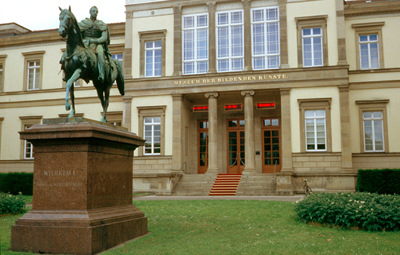
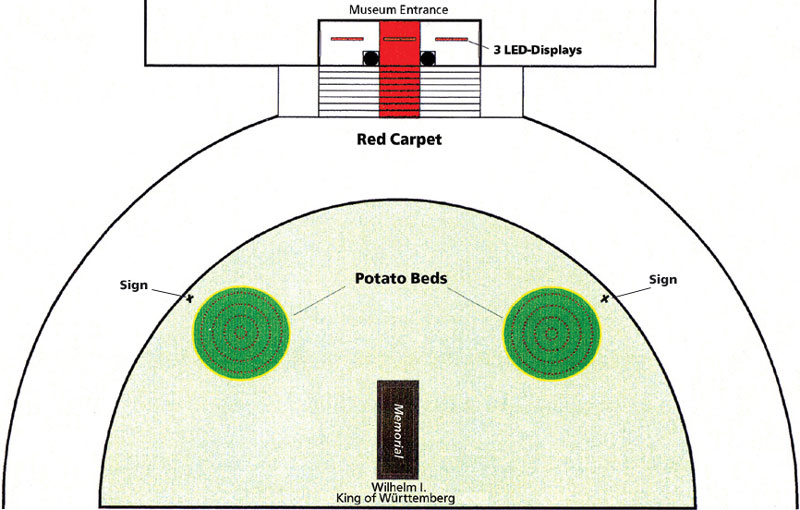
Our piece is readdressing the attention of the passer-byes and the visitors of the museum from the post modern museum extension by James Stirling back to the entrance area of the classicist Staatsgalerie. The classicist museum and it's Cour d'Honneur is dedicated to the King of Württemberg. His equestrian statue on a high pedestal stands in a central position on the green in front of the building.
Commissioned as a centerpiece for that space our work links history, the values, possessions and the tasks of a museum. Questions about art and life, the role of art as catalyst for social and cultural developments, our tolerance and our capacity for new visions and insights evolve.
We tried to create an environment that fits in this space like a glove, combining the existing traditional artifacts with unobtrusive additions and the use of electronics, resulting in a dialogue between art, nature and technology.
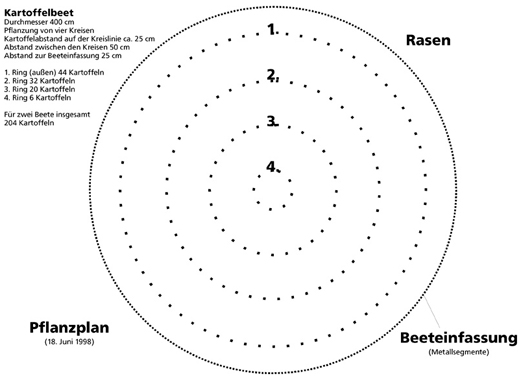
The new additions are: two potato beds on the green grass, a red carpet on the stairs leading up to the Portikus and three electronic screens in between the columns right in front of the entrance. Two round potato beds with golden frames are located to the left and right of the equestrian statue. The red carpet links the view and the steps of the visitors to the red text on the screen, guiding into the museum. The reassuring underlying message is: "Here I come and I'm welcome in the museum."
The bright light of the screens displays the names of the artists and their works in the collection inside the building like a continuos flow, reinventing the traditional habit to attach the names of great artists at buildings dedicated to the Fine Arts.
Every name stands for a unique vision, a body of work, a reminder for new encounters and experiences, inviting the viewers to come inside and to study it in detail. After the potato harvest the two golden frames stayed empty until Spring.
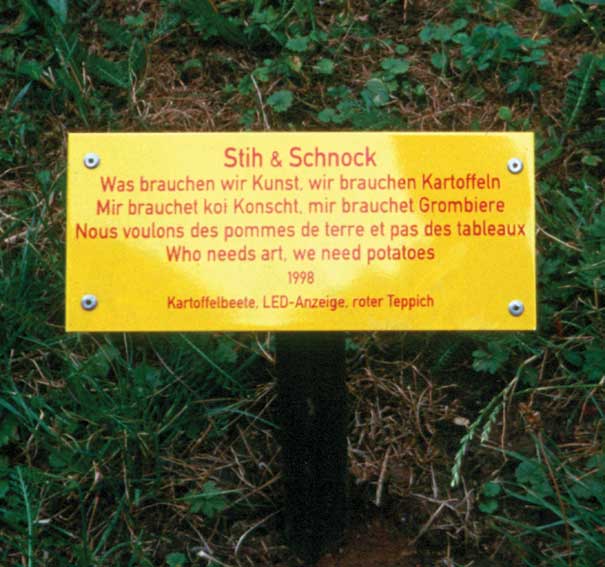
sign next to the potato beds, 1998-2008
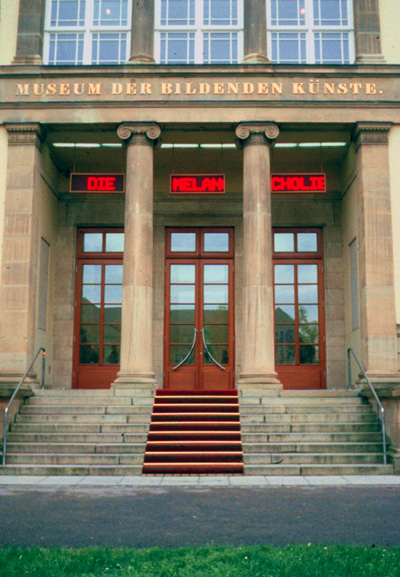
left: LED-display above the entrance into the classicist museum building, 1998-2008
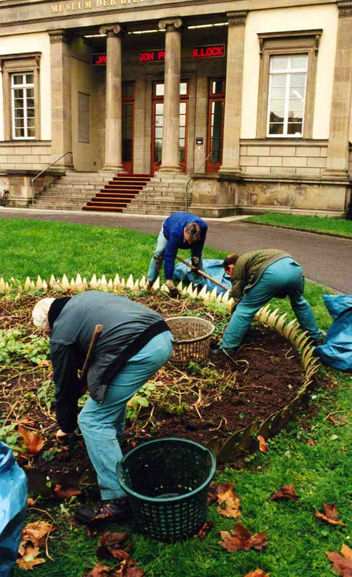
right: potato harvest, Autumn 2000 (potatoes to be given to the animals in the Wilhelma Zoo)
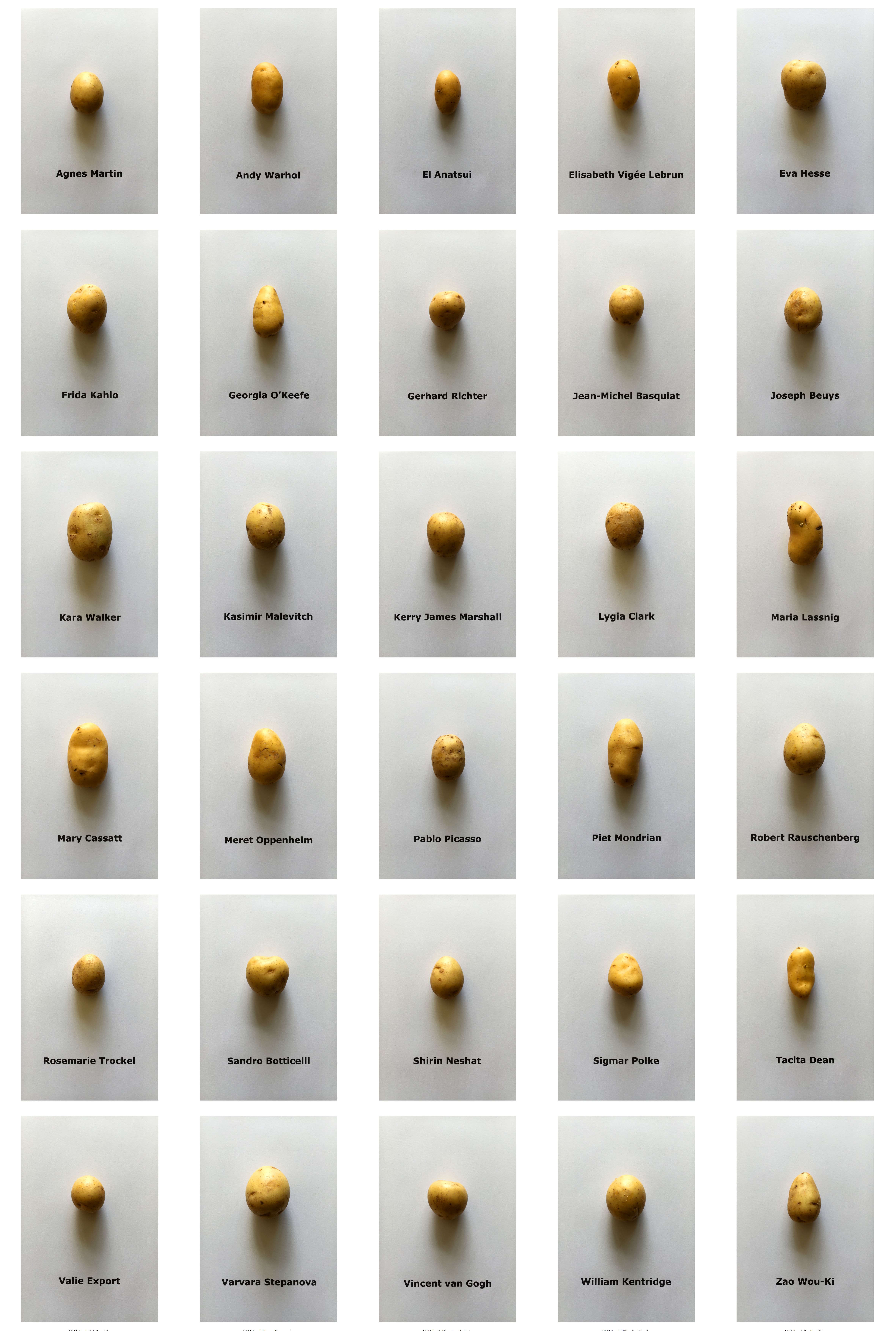
The following photographic series “Potato Portraits” is based on Renata Stih’s and Frieder Schnock’s environmental, multi-media installation for the Cour d'honneur of the Staatsgalerie in Stuttgart: Who Needs Art, We Need Potatoes (1998 - 2008) representing the philosophical link between art and food. It is a work-in-progress, a continuously growing collection from art history; the archival methodology refers to structures of art cyclopedias and Vasari's Lives of Artists in particular. Every name stands for a unique vision, a body of work, is a reminder for new encounters and experiences.
Edition of 5 + 1 AP, archival pigment print on 308 gr Hahnemuehle Photo Rag
size 20 x 30 cm, image size 18,7 x 28 cm (7 9/10 x 11 4/5 in, image size 7 1/3 x 11 in)
(available at www.artsy.net)
(...) open series (every artist is a root)
© text & images: Stih & Schnock, Berlin / VG BildKunst / ARS NYC